
Rates of Reaction (Gas Syringe)
GCSE
IGCSE
A-Level
High School
AP
Make it your own
Load this set up into Chemix to make changes and export your diagram.
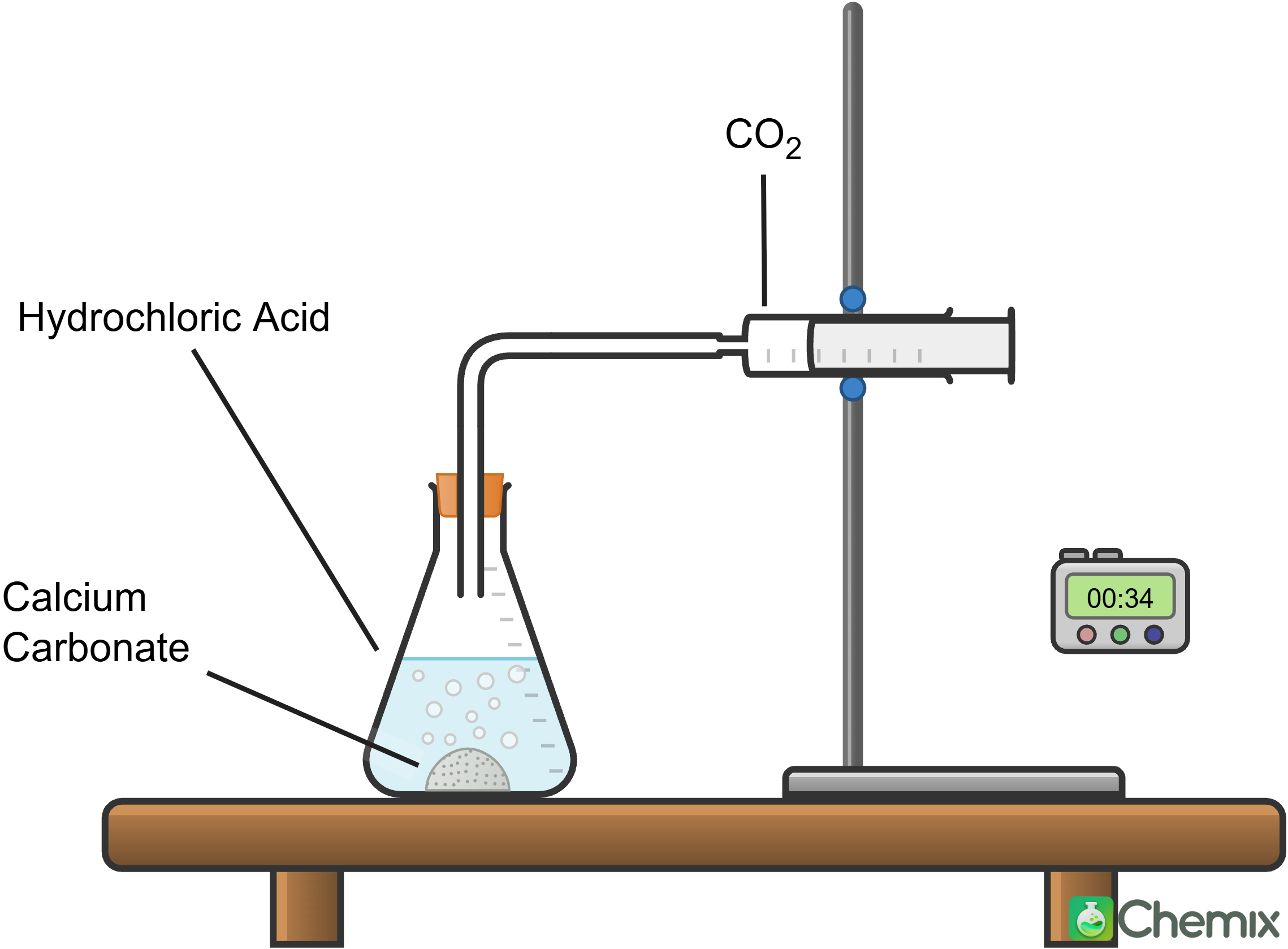
Edit in ChemixMeasure the rate of a chemical reaction that produces a gas by recording the volume of gas collected in a gas syringe at regular time intervals. Because the syringe is a closed system with low friction, it provides precise volume measurements for both soluble and insoluble gases, allowing students to compare reaction rates across different experimental conditions such as reactant concentration, particle size, temperature, or presence of a catalyst.
Common classroom experiments and real-world applications include:
- Reacting calcium carbonate (powder vs. marble chips) with hydrochloric acid to measure carbon dioxide evolution and investigate how surface area or concentration alters the rate of reaction
- Decomposing hydrogen peroxide with a manganese(IV) oxide catalyst to measure the rate of oxygen production
- Reacting magnesium or zinc with dilute hydrochloric or sulfuric acid to track hydrogen gas evolution and determine the order of reaction
- Assaying the purity of solid carbonates or reactive metals by measuring the final volume of gas evolved at room temperature and pressure (RTP)