
Hooke's Law & Spring Extension
Key Stage 3
GCSE
IGCSE
A-Level
Middle School
High School
AP
IB
Make it your own
Load this set up into Chemix to make changes and export your diagram.
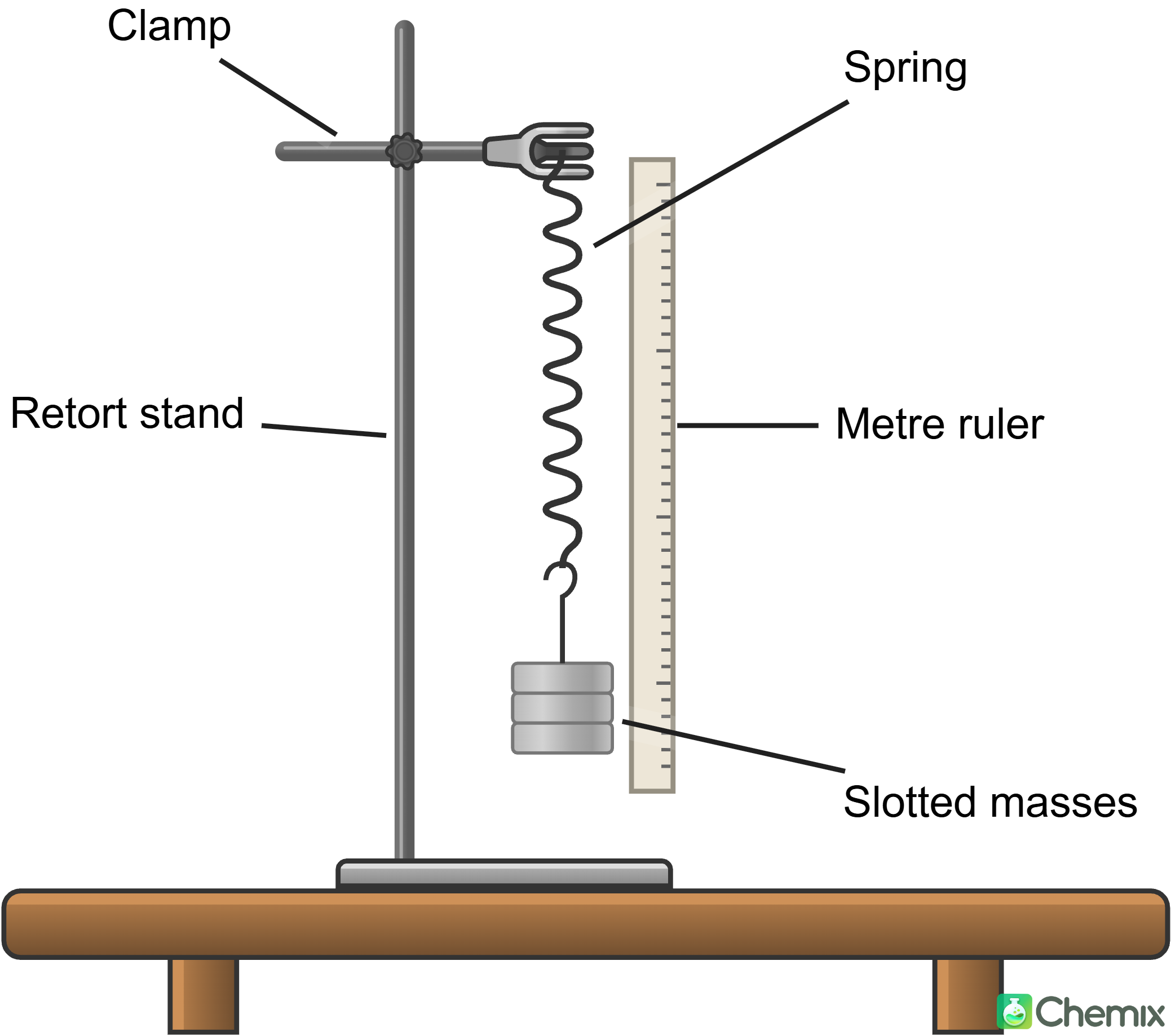
Edit in ChemixInvestigate the relationship between the applied load (force) and the resulting extension of an elastic material such as a helical spring. By adding known masses incrementally and measuring the change in length from the spring's unloaded equilibrium position, students verify Hooke's Law (F = ke)—the extension is directly proportional to the applied force up to the limit of proportionality, and the gradient of the force–extension graph gives the spring constant (k).
Common classroom experiments and real-world applications include:
- Determining the spring constant (k) of steel springs or comparing springs connected in series and parallel
- Investigating elastic vs. plastic deformation by loading a spring or copper wire past its elastic limit to observe permanent extension
- Calibrating a newtonmeter (spring balance) using known standard masses to measure unknown forces or weights
- Designing suspension systems, shock absorbers, and mechanical scales in engineering, where predictable elastic deformation is required